
This sample project represents a fully automated interconnection study for a major utility company in NY State. The study was in compliant with Coordinated Electric System Interconnection Review (CESIR), which is mandated by the New York Public Service Commission.

Project Description
The system under study in this example is composed of 5 feeders connected to a substation. The system raw data was exported from CYME as CYME ASCII files including Equipment, Network, and Load ASCII files. The files were then imported into IQ. Tables below summarize system characteristics.
Substation Transformer Peak Load (kW) | 21,185 |
|---|---|
Number of Feeders Served from this Bus | 5 |
Substation Transformer Summer Normal Rating (kVA) | 26,000 |
Supply Voltage (kV) | 69 |
Generation: Total , Connected, Queued Ahead (kW) | 25,606; 9,084; 14,522 |
Daytime Light Load (kW) | 6,361 |
A new PV system was proposed to interconnect to one of the feeders, called "interconnection feeder" in this project. Table below lists the interconnection feeder information.
Interconnection Feeder Peak Load (kW) | 4,191 |
|---|---|
Zero Sequence Impedance at POI | 1.93058+j4.26557 pu |
Positive Sequence Impedance at POI | 0.66867+j2.04634 pu |
Line to Ground Fault Current at POI | 1,470 A |
3-Phase Fault Current at POI | 2,044 A |
Generation on Interconnection Feeder: Total, Connected, Queued Ahead(kW) | 2,230; 208; 22 |
Line Phasing at POI | 3 |
Interconnection Feeder Primary Voltage at POI (kV) | 13.2 |
Interconnection Feeder Daytime Light Load (kW) | 1,221 |
The proposed PV system consists of:
-
Five thousand two hundred and twenty (5,280) three phase Hanwha QCell 480 W Solar Panels for a total DC size of 2,534.4 kW.
-
Sixteen (16) three phase Chint CPS SCH125KTL-DO/US-600, 125 kW / kVA, 600 V, inverters for a total AC output of 2,000 kW / kVA.
-
One (1) 2,000 kVA, three phase 13.2 kV grounded-wye primary to 600 V grounded-wye secondary, pad/vault mounted, interface transformer with 5-legged core, with an impedance of Z = 5.75% and X/R = 9.
-
One (1) 112.5 kVA, 600 V grounded-wye primary to 208 V delta secondary grounding transformer with an impedance of Z = 4.8% and X/R >= 4.
-
One (1) Customer riser pole with one (1) Customer owned revenue meter and one (1) set of 8.4 kV MCOV lightning arrestors.
-
One (1) Customer pole with one (1) Utility owned primary meter.
-
One (1) Customer owned pole with one (1) disconnect switch of an unknown manufacturer and one (1) S&C SMU-20 100K fuse rated for 15kV and 200A.
The CYME model of the system didn't converge when a simple power flow analysis was performed in CYME. When integrating CYME data into IQ, the data will be processed and all of the data inconsistencies, errors, and other issues in the data will be fixed automatically and the models will be converged in power flow analysis. Please see CYME Data Integration sample project for more information on how IQ integrated the data and generated system models.
NY CESIR Automation in IQ
A NY Coordinated Electric System Interconnection Review (CESIR) is a detailed technical study performed by a New York utility for DER projects. The CESIR assesses the project's potential impacts on the electric grid's safety and reliability, including concerns like protective coordination, fault current, thermal limits, voltage, and power quality, and determines necessary upgrades or modifications. More information on CESIR can be found here.
IQ's automated solution for NY CESIR complies with all CESIR requirements. After generating and validating the models directly from CYME ASCII files, IQ starts interconnection study, seamlessly, as instructed in CESIR. In what follows we present the results of the study and show how IQ publishes the results in CESIR template as the final report for the interconnection application. Please note that some of the information has been redacted in the result for confidentiality reasons.
Figure below shows the snapshot of IQ's graphical user interface (GUI) which was customized in compliance with NY CESIR. One of IQ's powerful feature is its flexibility to be customized for different requirements. The first step in the study is to define the project which includes the information about application (DER characteristics, location, customer, etc.). Please note that IQ can be integrated with utilities administrative management systems such as Salesforce for bidirectional data exchange and request intake via web forms or APIs. If this option is taken, the project will be created automatically by pulling all information directly from the management system.
IQ's GUI Designed for NY CESIR Requirements

The next step is to generate and validate system models. The system raw data was exported from CYME, as CYME ASCII files which include Equipment.txt (Equipment database), Network.txt (Network database), and Load.txt (Load database). Substation fault currents were also provided for protection analysis. The CYME ASCII files were imported and system models were generated automatically. Due to variety of reasons distribution feeder data needs corrections and refinements in order to make the system model converge in power flow analysis. However, data cleansing could be tedious. With IQ's automated data cleansing feature, there is no need to spend any time or resources for this task. As an example, the CYME model of the feeder in this project did not converge. IQ diagnosed the issues in the raw data, corrected the issues, and generated the models. The models were validated and saved.
IQ's Model Generation
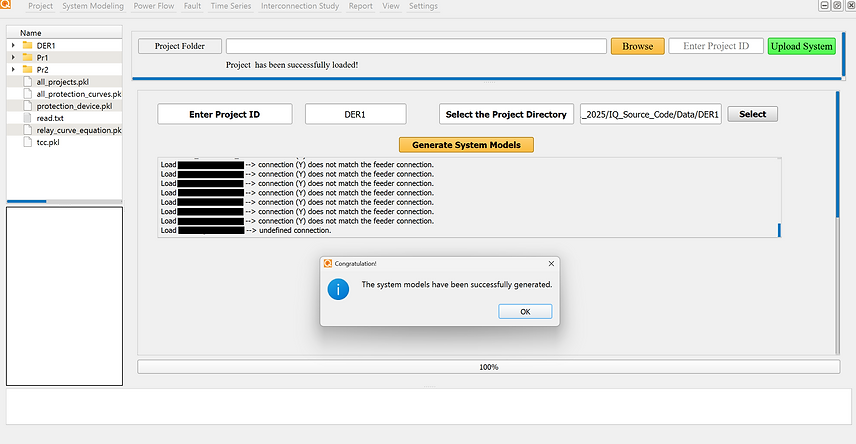
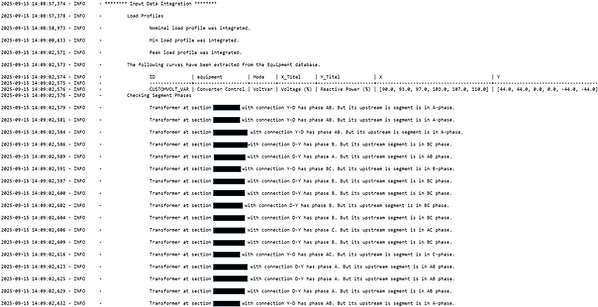
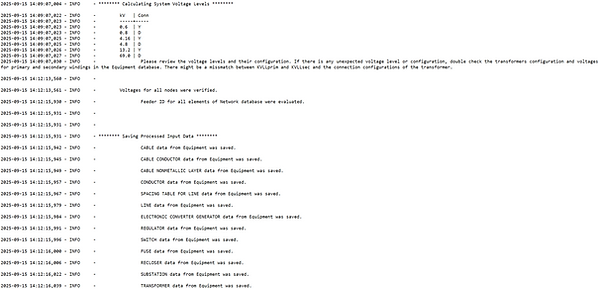
IQ generates a log file detailing the process to generate the models. The log file includes all the corrections applied to the raw data. Due to the long length of the log file content, some snapshots of different parts of the log file for this project are shown below.
Snapshots of IQ's Model Generation Log File


Reading CYME ASCII Files
Data Cleansing


Model Generation and Validation
Now CESIR study begins automatically. Figure below shows the snapshot of IQ's GUI for automated CESIR execution. The green "Run CESIR" button start the fully automated CESIR.
IQ's Automated CESIR
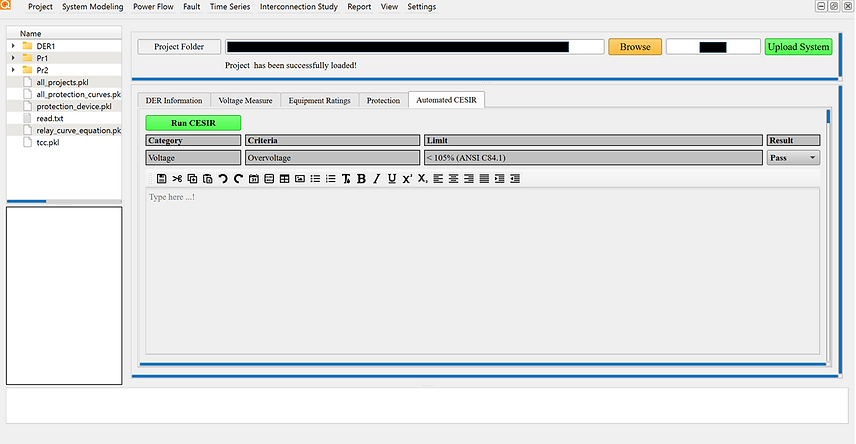
Figure below shows the snapshot of IQ after finishing full CESIR. Since there are a few failed measures in the analysis, IQ includes the optimal mitigations and their initial costs to address the failed criteria. The time from integrating the CYME ASCII files to the end of CESIR was below 5 minutes.
IQ's CESIR Analysis Snapshot
